Scotia Beading Corner Gaps Uk
Scotia and quadrant mitres gap when the skirting corner is not square, the trim is flipped in the mitre box, or the beading has been pinned in a way that fights the floating floor. Measure the corner, choose a mitre or scribe for that exact joint, dry-fit the pieces, and fix the beading to the skirting rather than trapping the floor.
Protect the expansion gap first
Scotia exists to cover the perimeter movement gap left around laminate or engineered flooring. ShunTool's scotia guidance notes that scotia or quadrant covers expansion gaps and that internal corners often need scribing where rooms are not square. The exact gap size should come from your floor manufacturer's instructions, but the principle is consistent: do not fasten the floating floor edge so tightly that it cannot move.
Why 45 degree cuts open
A mitre box slot is quick, but it assumes the corner is square. Overclockers UK forum users describe laminate beading mitres becoming a nightmare when walls are a degree or two out. Scotia is small, so the temptation is to force it. That often twists the next length and moves the gap somewhere else.
Choose the joint by corner
| Situation | Best move |
|---|---|
| Internal corner, painted scotia, uneven wall | Scribe or cope the internal joint if the profile allows. |
| External return | Measure and bisect the actual angle for two clean mitres. |
| Threshold or doorway | Use the correct threshold bar or end detail, not a random scotia return. |
| Hairline after dry-fit | Finish carefully; do not rely on filler for a wide wrong-angle cut. |
Step-by-step trim workflow
- Vacuum the perimeter so grit does not hold the beading away from the skirting.
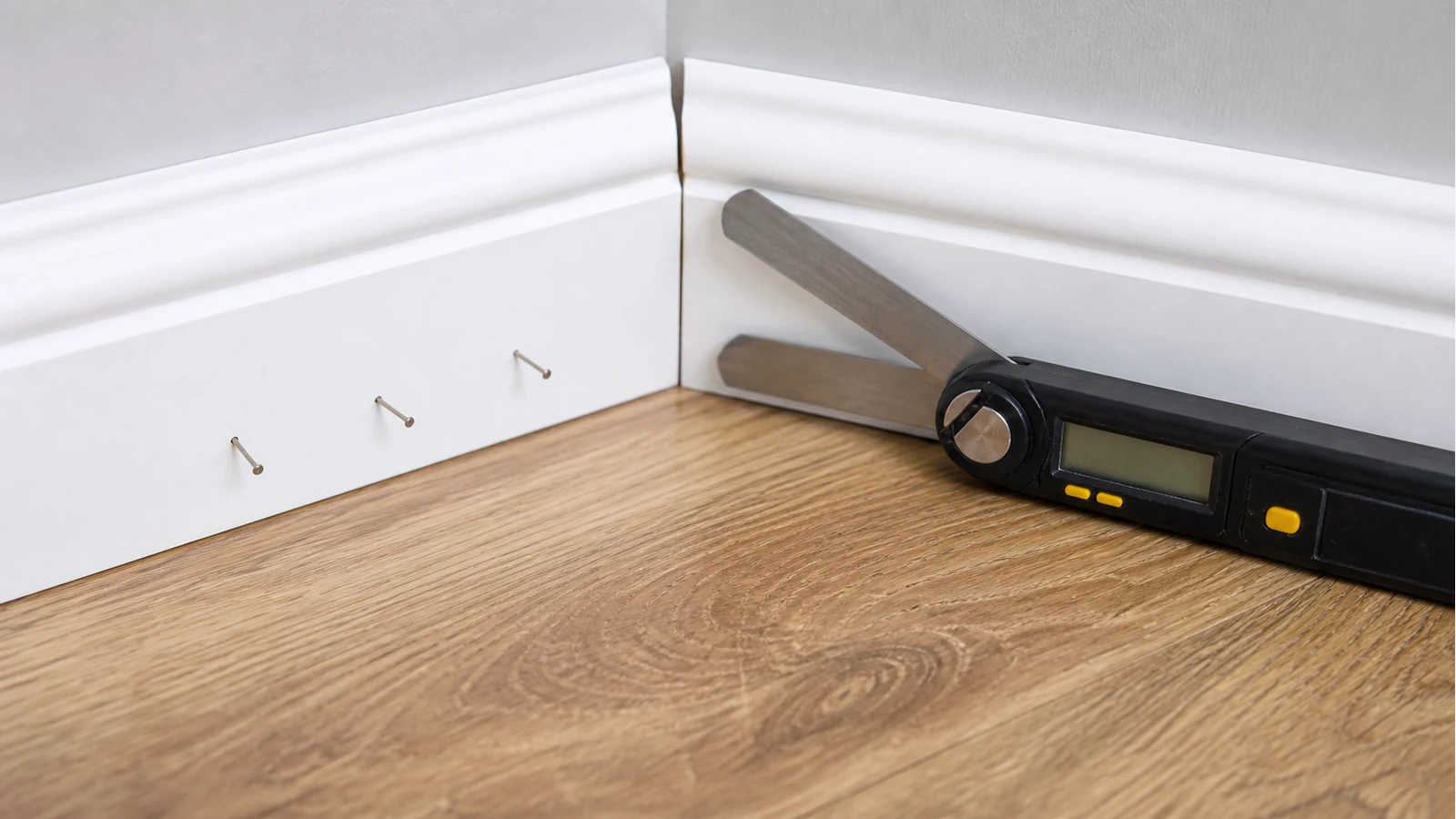
- Read the corner with a hinged angle finder if it looks off square.
- Mark the back of each beading length with its wall, direction and cut end.
- Cut scrap tests for the first awkward corner.
- Dry-fit without pins. The joint should sit naturally.
- Pin or bond to the skirting face, following your flooring system's advice, not down into the floating floor.
Retailer fitting guidance
Atkinson & Kirby's advice covers 45 degree scotia mitres for corners and adjusting the fit when joints are imperfect. That is the right balance: start from standard trim practice, then let the real wall corner correct the cut.
Stop conditions
Stop and rethink if the floor edge is still moving, if the expansion gap is missing, if damp has swollen the floor, or if the corner problem is actually a bowed skirting board. Measuring the angle will not fix those causes.
If your missing step is reading the actual corner rather than guessing at 45 degrees, the LEXIVON detail page is the same-site route for a hinged angle finder. For related moulding choices, see skirting scribe or mitre and coving mitres out of square.