Skirting Board Scribe Or Mitre Uk
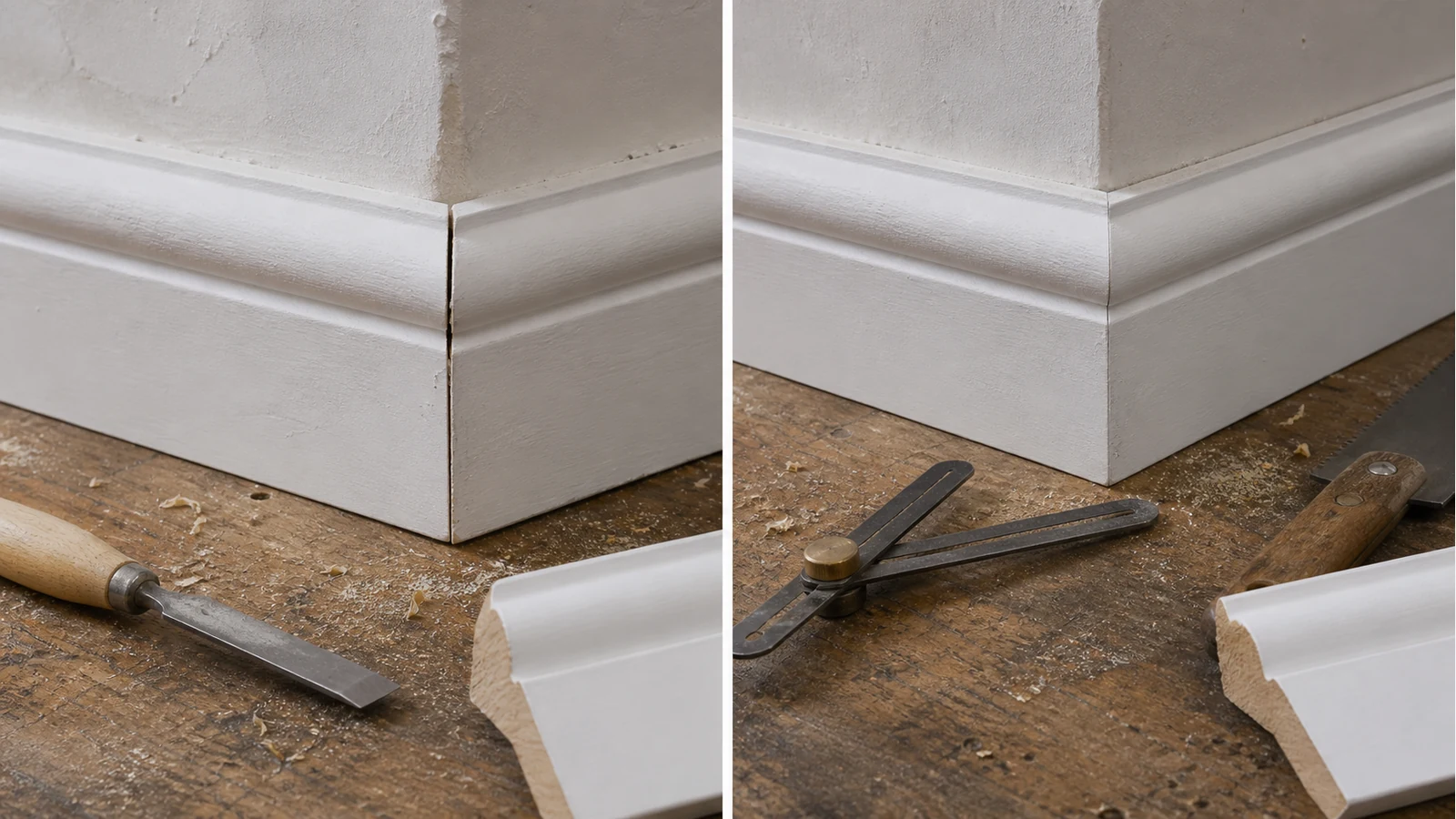
For most internal skirting board corners in UK homes, scribe or cope the joint rather than relying on two 45 degree mitres. Use mitres mainly on external corners, returns, and situations where the profile or layout makes a measured mitre the cleaner choice. Measuring still matters when the corner is not square, especially on bays, chimney returns, and badly plastered walls.
The decision table
| Corner type | Best first choice | Why |
|---|---|---|
| Internal room corner | Scribe/cope | More forgiving when walls are not square and when timber moves. |
| External corner | Measured mitre | The cut edge is visible, so the two faces need to meet cleanly. |
| Bay or angled wall | Measure, then mitre or adapt the scribe | The corner may be far from 90 degrees. |
| Preformed corner block system | Follow the kit | The block hides the joint geometry. |
Why trades often scribe internals
DIYWiki explains that scribed joints tolerate out-of-square rooms and movement better than internal mitres. In plain terms, one board runs square into the corner, and the second board is cut to follow the face profile of the first. The visible line is the moulding profile, not a long diagonal mitre that opens when the wall is 88 or 93 degrees.
BookaBuilderUK's skirting guide also describes using scribes for internal corners and checking angles when corners are significantly out of square. That is the balanced rule: scribe where it helps, measure where the geometry is still doing real work.
Why internal mitres open
Two 45 degree cuts assume a square room. Charlie DIYte's skirting explanation shows why internal 45 degree mitres can open when walls are not exactly 90 degrees. If you are painting MDF, caulk may disguise tiny imperfections, but it should not be the plan for a wide V-shaped gap.
Where a digital angle finder still helps
An angle finder is not a replacement for learning to cope a profile. It is useful for diagnosing the room before cutting: checking whether an internal is close enough to scribe normally, reading a bay corner, measuring a chimney breast external, or checking whether your saw's 45 degree stop is drifting. A hinged digital protractor is the relevant style for wall corners; a magnetic cube gauge is a different tool for machinery surfaces.
Negative fit: when not to buy a measuring tool just for this
If you are fitting one square room with corner blocks, or if all internals will be coped with generous painted profiles, a separate digital angle finder may be unnecessary. Spend the time on sharp coping cuts and careful dry-fitting instead.
Practical workflow
- Label every corner as internal, external, bay, return, or kit block.
- Scribe standard internals first.
- Measure externals and angled walls individually.
- Cut scrap tests for the oddest corner before using full lengths.
- Dry-fit, then fix. Do not ask caulk to replace a joint.
If the measuring step is the part holding you up, the LEXIVON detail page is the same-site route for a hinged digital angle finder. For a highly visible external, see chimney breast skirting external mitres. For floor edge trim, compare scotia beading corner gaps.