Coving Mitre Out Of Square Uk
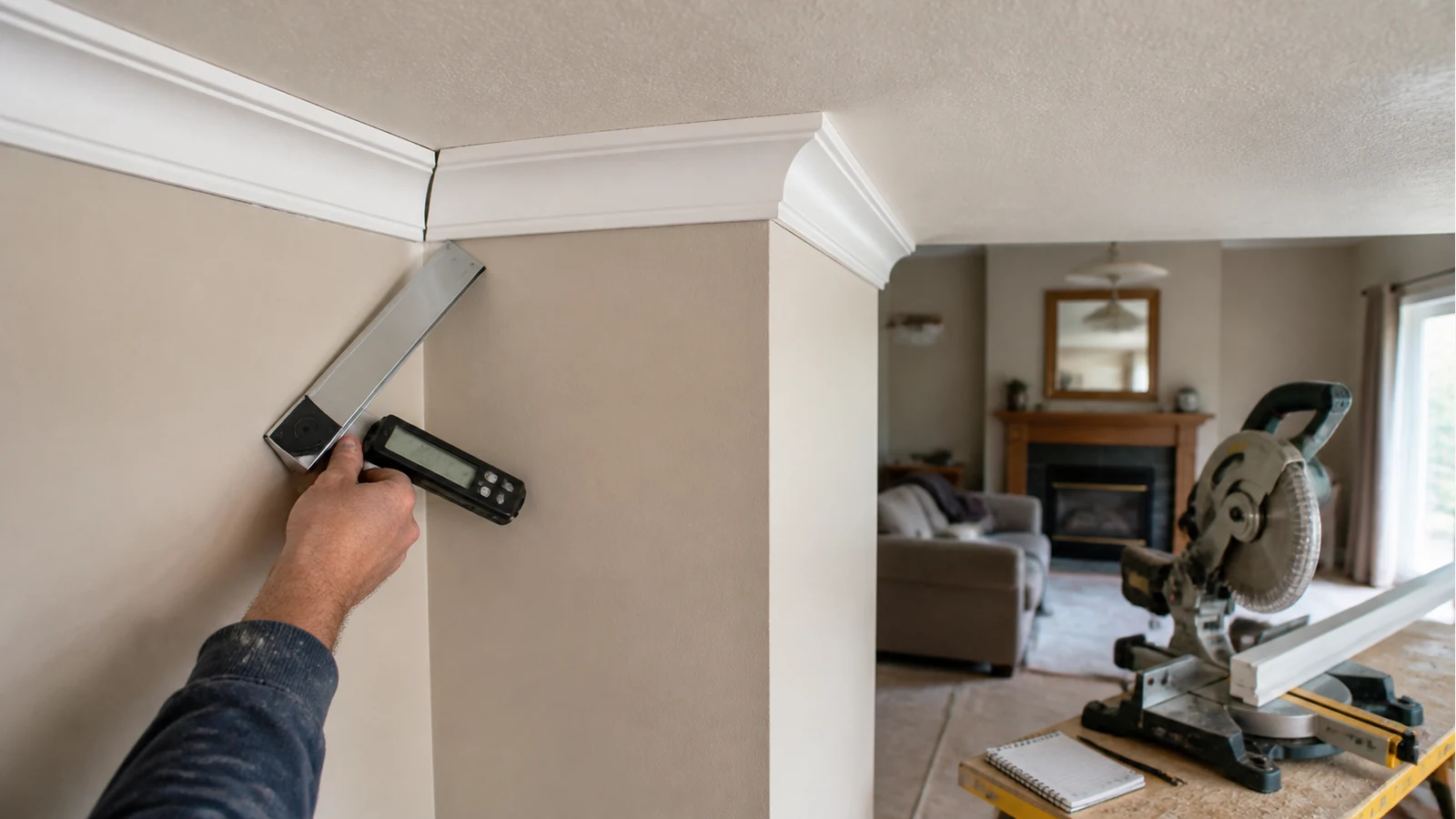
If a plaster coving internal corner opens up after two 45 degree cuts, the usual problem is simple: the wall and ceiling corner is not a true 90 degrees. Filler can tidy a hairline, but it will not rescue a visibly wrong mitre. Measure the actual corner first, halve that reading for the two matching cuts, then dry-fit before adhesive.
This is especially common in older UK rooms where plaster, ceiling lines and wall corners have moved over time. A fixed mitre block assumes square corners. Your room may not.
Why the 45 degree habit fails
A 90 degree internal corner needs two 45 degree faces. If the corner is 94 degrees, each cut wants to be about 47 degrees. If it is 86 degrees, each cut wants to be about 43 degrees. That small-looking difference becomes a long open shadow line on coving because the profile projects out from both wall and ceiling.
Property Workshop's coving guide describes checking non-square corners with an angle finder or protractor before dividing the angle for the cut. DIYnot discussions show the same failure pattern in real houses: fixed 45 degree cuts are often the wrong answer when the corner is untrue, and users move towards measurement or adjustable saw setups, as in this DIYnot thread on untrue coving corners.
Measure, bisect, then dry-fit
- Offer a short coving offcut into the corner so you understand how the profile sits.
- Measure the wall corner with a hinged protractor or angle finder. Keep the tool seated on the wall faces, not floating on lumps of plaster.
- Divide the angle by two for a simple equal mitre.
- Set the mitre saw or adjustable mitre box to that half-angle, checking which face of the coving is against the fence.
- Cut two scrap test pieces first. If they close neatly, cut the real lengths.
- Dry-fit the joint before adhesive. Adjust now, not after the coving is wet and sliding.
When scribing or templates beat a forced mitre
If the corner changes along its height, or the coving profile is ornate and the surfaces are lumpy, the mathematical mitre may still look poor. In those cases, use short templates, coping, or a scribed approach so the visible profile closes tighter. DIYnot's discussion of gaps in internal coving mitres is a useful reminder that not every internal corner should be treated as a perfect geometry exercise.
Do not copy one corner around the room
Measure each corner individually. The front left corner of a Victorian terrace room can be several degrees different from the rear right corner. If you cut every piece from the first reading, the last two joints often become the worst ones.
A practical proceed-or-stop check
- Proceed with measured mitres when both wall faces are reasonably flat and the angle reading is repeatable.
- Use scrap tests when the profile is expensive, painted, or hard to replace.
- Switch to template or scribe work when the corner is twisted, crumbling, or inconsistent along the profile.
- Use filler only for small finishing lines, not as the main joint strategy.
If you do not already have a way to read and transfer the real corner angle, a hinged digital angle finder can make this job less guessy. The relevant product route is the LEXIVON detail page; use it only if measuring corners is the missing step in your workflow.
Related guides
For skirting decisions, compare scribe versus mitre for UK skirting. For floor trim, see scotia beading corner gaps.