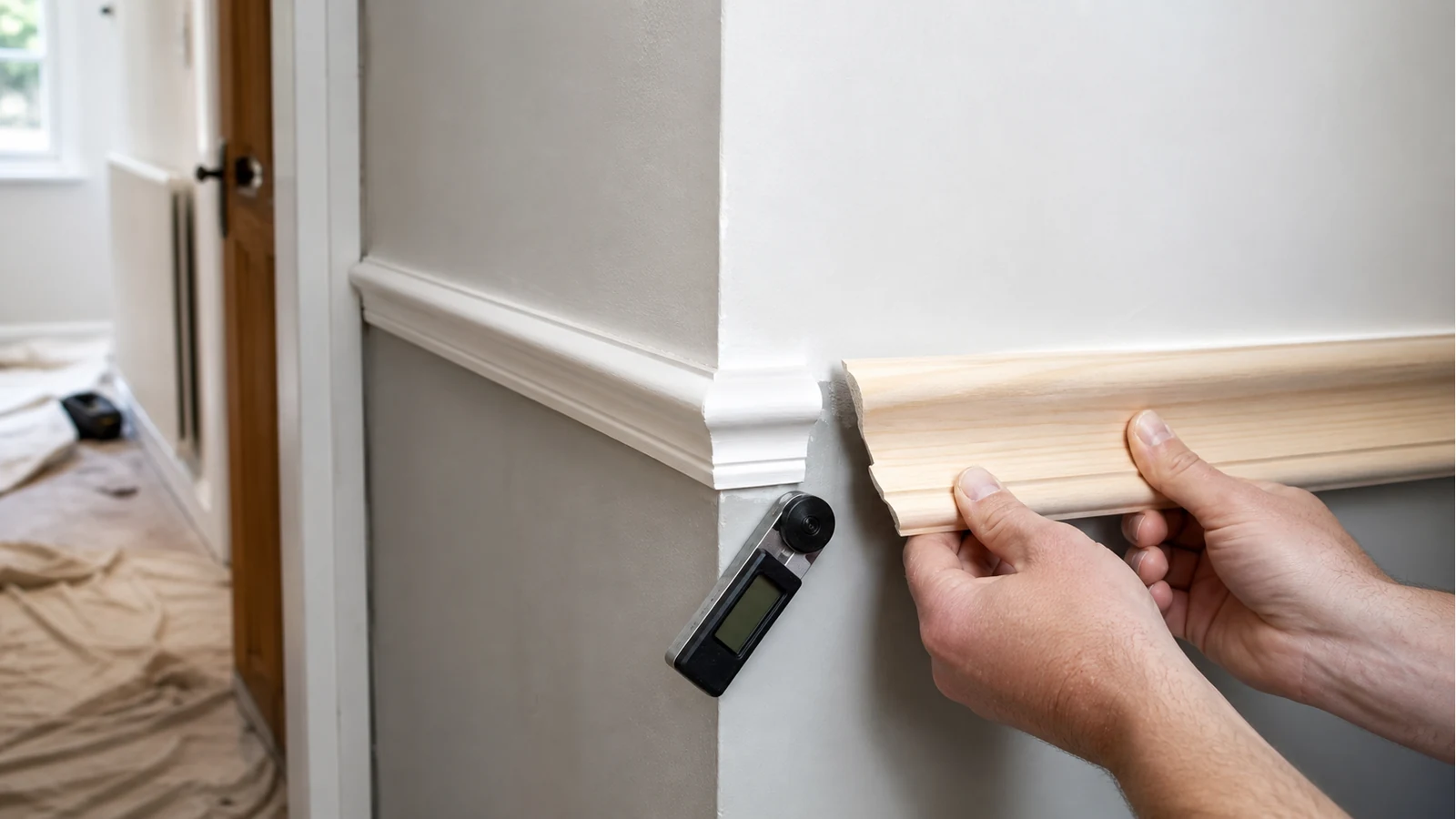
Dado Rail Internal Corner Cope Uk
For most dado rail internal corners, cope or scribe the second piece into the first rather than forcing two 45 degree mitres. Measure the corner when the room is bay-shaped, the rail must mitre for design reasons, or the wall is so far out that the cope needs an adjusted undercut.
Internal is not external
An external dado corner has two visible mitred faces. An internal corner has one rail running into the wall and a second profile meeting it. That is why coping is often cleaner inside: the visible line follows the moulding profile rather than exposing a diagonal joint.
TradeCalculator's dado rail guide recommends coping internal corners and adjusting mitres on externals that are not exactly 90 degrees. Skirting4U's guide similarly notes that internal dado corners are often better coped because walls are rarely perfectly square.
The basic coping sequence
- Mark and level the dado line around the room.
- Fix or hold the first length square into the internal corner.
- Cut a 45 degree reveal on the end of the second piece to expose the profile line.
- Use a coping saw or suitable fine saw to cut along that profile line.
- Back-cut slightly so the front edge meets neatly.
- Test-fit, then pare or sand small high spots.
When measurement still earns its place
Do not read this as a rule that angles never matter. Measure when the internal corner is not a normal 90 degree room corner, when the dado continues around a bay, when the profile is too simple to cope cleanly, or when you need to diagnose why a coped piece will not sit flat.
DIYWiki's scribed-joint guidance applies beyond skirting; it includes picture rails and similar mouldings where a shaped internal joint can tolerate imperfect corners. Dado rail sits in that same family of wall mouldings.
Decision checklist
- Standard internal corner with shaped dado: cope first.
- External corner or chimney-style return: measure and mitre.
- Bay-like internal angle: measure before deciding.
- Square-edge rail being painted: a neat butt may be acceptable.
- Large gap after coping: check wall bow, rail twist and level line before recutting.
What not to overclaim
A digital angle finder will not make a blunt coping saw cut a clean profile, and it will not straighten a twisted rail. It helps when the real corner angle is unknown or when you need to transfer a measured angle back to a saw setup.
If that measuring job is the missing part, the LEXIVON detail page is the same-site route. For the companion external topic, use dado rail external corner angles. For closely related skirting choices, read skirting board scribe or mitre.