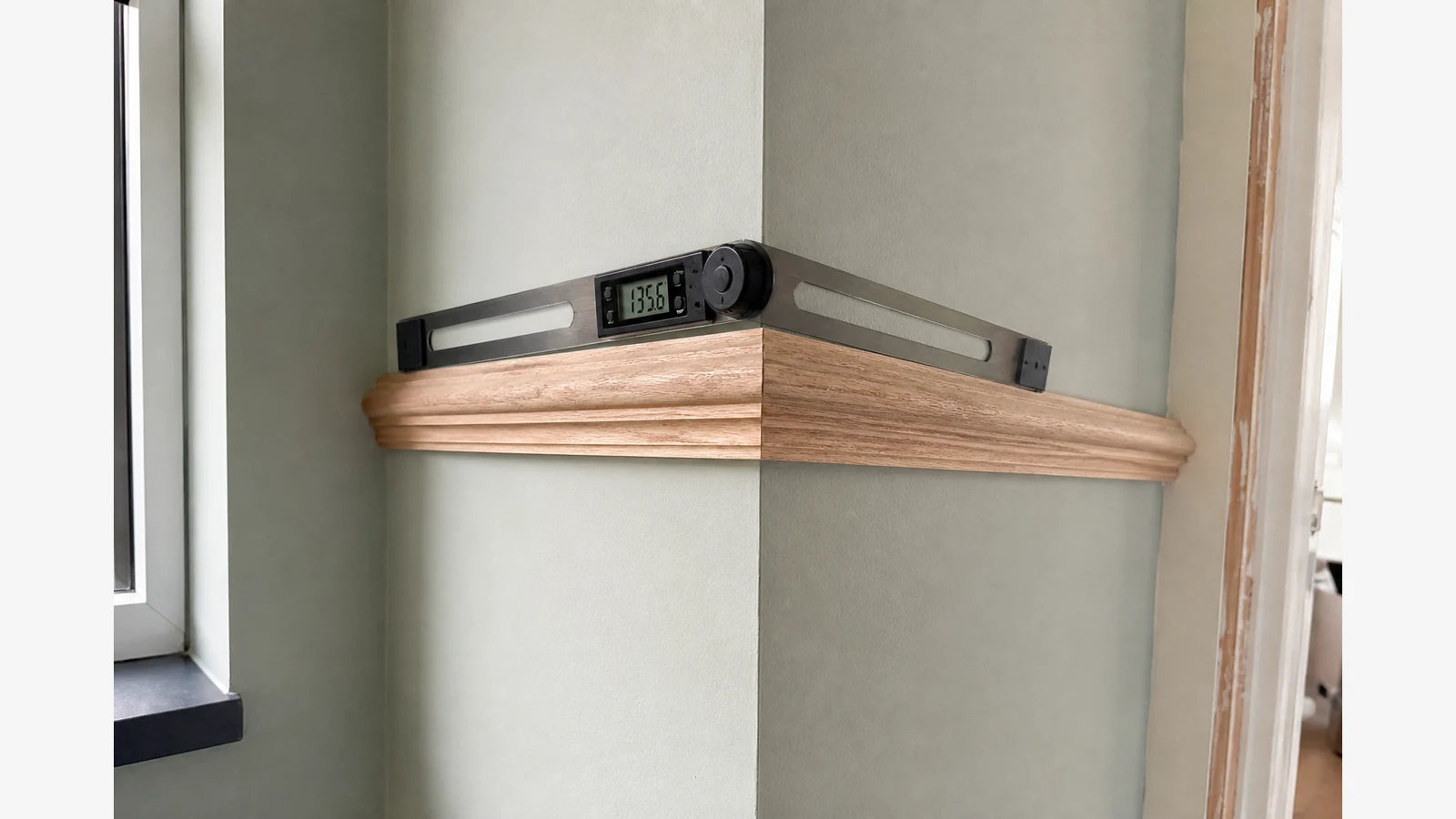
Dado Rail External Corner Angle Measure Uk
For external dado corners, measure the wall angle first, then set each mitre to half that reading. A forced 45° cut only works when the corner is truly square; on many Victorian and Edwardian walls it is not, and the rail opens a hairline after decorating.
External mitre checklist
- Strike a level line at the intended rail height around the room (common practice varies by room proportion — it is not a legal height rule).
- At each external corner, seat a digital angle ruler on both wall faces and record the reading.
- If the reading sits outside roughly 89–91°, do not force 45°. Bisect the measured angle for each opposing mitre.
- Cut a scrap pair and dry-fit on the corner with the rail face out.
- Cut finished lengths, glue the mitre faces, pin back to the wall, and caulk only residual wall gaps — not a geometric tip gap.
Square-looking walls that still need measuring
Older UK walls can look plumb until a continuous moulding line exposes a degree or two of wander. Fitting guides for dado rails note that external corners usually need matching mitres, and that you should check the angle and divide by two when walls are not square. Trade calculators likewise treat 45° as the square-corner default and tell you to adjust when the corner is not exactly 90°.
Internal corners: different method
Profiled internals are often better scribed or coped so the profile nests; externals are where measured opposing mitres earn their keep. Do not assume one joint type always wins — choose by corner type and how much profile you need to show.
Useful decision table
| Corner reading | Mitre each piece | Next action |
|---|---|---|
| About 90° (≈89–91°) | ≈45° | Scrap dry-fit once, then cut stock |
| Clearly obtuse or acute | Half of measured angle | Scrap dry-fit; recheck saw scale |
| Wavy plaster near the corner | Half of best flush reading | Back-cut lightly; avoid packing the tip with filler |
A readable digital angle ruler keeps the saw setting matched to the wall without a separate protractor transfer. Next step: keep one hinged unit with your second-fix kit for every external return on the same floor.