Picture Rail Corner Mitre Measure Uk
For picture rails, cope or scribe most internal joints so the profile nests, and measure-and-bisect for external mitres. Assumed 45° cuts only suit truly square corners; on older terraces, walls move and floors settle, so gaps show quickly if you guess.
Comparison: assumed 45° versus measured half-angle
| Approach | Best when | Risk |
|---|---|---|
| Assumed 45° external mitre | Corner reads ≈90° | Hairline opens after paint if walls wander |
| Measured half-angle external mitre | Corner clearly out of square | Takes one extra measurement; still needs dry-fit |
| Internal cope/scribe | Profiled rail on internal corners | Needs a clean mitre to reveal the profile first |
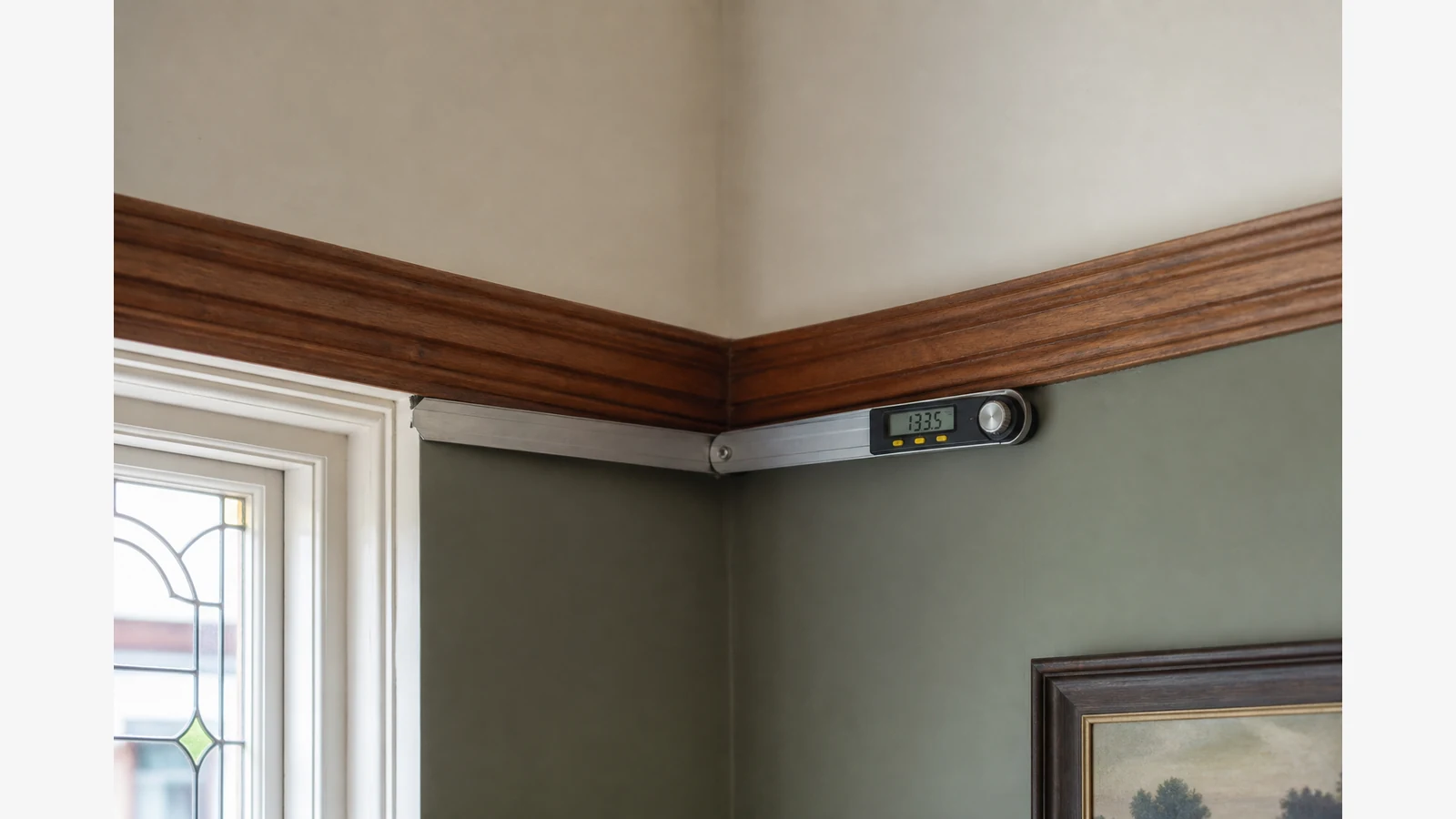
UK DIY guidance on scribed joints covers skirtings, picture rails and similar mouldings, and the method adapts when corners are not 90°. For corners significantly out of square, measure with a bevel or angle finder and split the reading for external mitres. The same external measure-and-divide geometry used on dado rails transfers to horizontal picture rails.
Decision table
- Internal profiled rail: cope or scribe after revealing the profile with a mitre.
- External corner: measure the wall angle, bisect, cut opposing mitres.
- Short returns: dry-fit twice; length errors look like angle errors.
- Severely bowed walls: expect some wall-line caulk; do not promise filler-free faces.
Do not confuse with coving charts
Picture rail is a horizontal wall moulding. Coving and cornice spring-angle charts are a different geometry — do not copy those tables onto rail mitres.
A digital readout removes protractor transfer errors when you set the saw for externals. Next step: use a hinged digital angle ruler for every external return on the floor before cutting finished lengths.