Lexivon Digital Protractor: The Complete 2026 Guide to Angle Measurement Tools
A practical, hands-on guide to choosing and using a digital protractor for DIY, woodworking, and professional trades — covering everything from basic protractor meaning to advanced digital sliding T-bevel angle finders.
What Is a Protractor? Meaning, Types & Evolution

A protractor is a measuring instrument used to determine or mark angles, typically graduated in degrees from 0° to 180° (semicircular) or 0° to 360° (full circle). That's the textbook definition. But honestly, if you've ever tried cutting a mitre joint with a cheap plastic school protractor, you'll know that definition barely scratches the surface of what you actually need on a job.
I grew up around Belfast — the kind of place where you learn to do things yourself or pay through the nose. My first experience with a protractor set was at school, squinting at tiny markings on a translucent semicircle. Fast forward to 2026, and the tools have changed dramatically.
Traditional Protractors
The classic semicircular protractor — that's what most people picture. Transparent plastic, printed degree markings, a small hole at the centre for alignment. Decent for geometry homework. Rubbish for anything requiring real precision. You're lucky to get within ±2° accuracy on a good day.
Bevel Protractors
A step up. These use an adjustable blade attached to a graduated dial. Machinists and metalworkers have relied on them for decades. They're more accurate — typically ±0.08° on quality models — but reading the vernier scale takes practice and good eyesight.
Digital Protractors
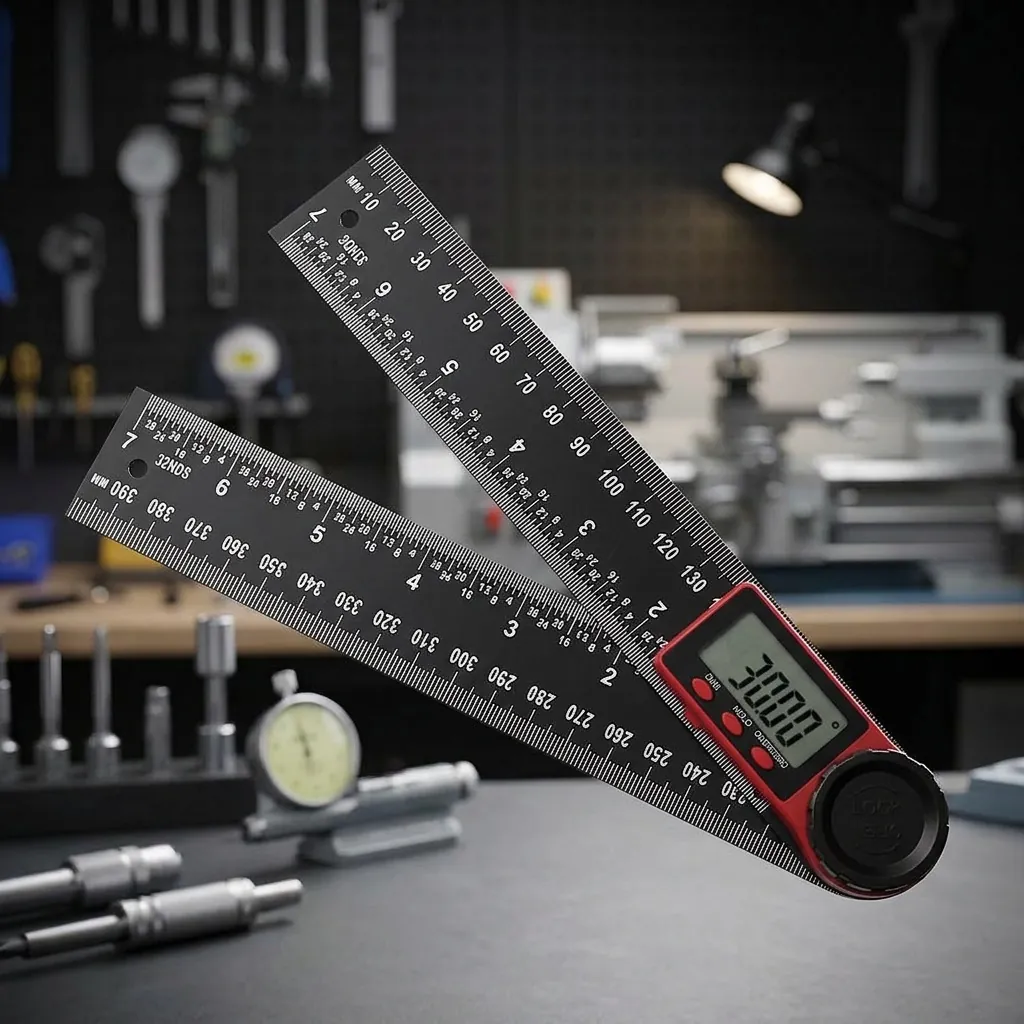
Here's where things get interesting. A digital protractor replaces analogue scales with an electronic sensor and LCD display. No squinting. No guesswork. Just a clear reading, often to ±0.1° or better. The Lexivon Digital Angle Ruler, priced at £33.19, is a brilliant example of how accessible this technology has become.
Online & Printable Protractors
Can you use a protractor online? Yes — there are browser-based tools and printable protractor PDFs available. They're free. They're also limited. A printable protractor depends entirely on your printer's accuracy, and an online protractor requires you to hold objects up to your screen. Handy in a pinch, but not something I'd trust for actual woodworking or tiling.
Why a Digital Protractor Beats the Old-School Alternative

Speed and accuracy — that's the short answer. But there's more to it than that.
I've tried cheaper alternatives over the years and they just don't cut it. A mate of mine was fitting a kitchen last spring in East Belfast. He'd been using a traditional bevel gauge, eyeballing angles where the worktop met an awkward bay window. Took him ages. I lent him my digital angle finder and he had every cut sorted in half the time. His words: "Why didn't I buy one of these years ago?"
Precision You Can Actually Trust
Traditional protractors rely on your ability to read tiny markings. Digital models display the angle on screen — ±0.1° resolution on the Lexivon unit. That difference matters when you're cutting crown moulding or setting a table saw blade angle. According to guidance from the British Standards Institution (BSI), measurement tools used in professional settings should meet recognised ISO standards for calibration and accuracy. Digital instruments make meeting those standards far simpler.
Hold & Lock Functions
Most digital angle measurement tools include a hold button. Measure an angle in an awkward spot — behind a radiator, under a cabinet — then lock the reading and take it to your saw. Can't do that with a plastic semicircle.
Reversible Readings
Need the complementary angle? Digital displays often show both the measured angle and its supplement simultaneously. No mental arithmetic required.
Lexivon Digital Angle Ruler: Full Specs & Why It's Worth £33.19

The Lexivon Digital Angle Ruler sits in that sweet spot between professional capability and DIY affordability. At £33.19, it undercuts many competitors while delivering features you'd expect at twice the price.
Key Specifications
- Price: £33.19 GBP
- Measurement Range: 0°–360°
- Resolution: ±0.1°
- Display: Large LCD with backlight
- Power: CR2032 battery (included)
- Material: Stainless steel rules with ABS housing
- Origin: Professional-grade precision product, proudly made in the UK
- Zero Function: Yes — set any position as reference zero
Look, I know the price seems steep compared to a £3 plastic protractor from the stationery aisle. But hear me out — the time saved and mistakes avoided on even one project will pay for itself. I've used mine for everything from checking door frame angles in older Belfast terraces (nothing's ever square in a house built before 1940) to setting up mitre cuts for skirting boards., a favourite among Britain’s tradespeople
The Lexivon digital sliding T-bevel angle finder is another option worth considering if you specifically need a bevel gauge format. It combines the traditional sliding bevel design with digital readout — perfect for transferring angles directly from workpiece to saw.
How to Use a Digital Protractor: Step-by-Step Guide

Using an electronic angle gauge is straightforward, but there are a few tricks that'll get you better results. Here's how I do it.
Step 1: Power On & Zero
Switch on the unit. The display should read 0.0° with both arms aligned. If it doesn't, press the zero/tare button. This recalibrates the reference point. Always do this before measuring — it takes two seconds and prevents cumulative errors.
Step 2: Position the Arms
Place one arm flat against your reference surface. Open the second arm until it sits flush against the angled surface you're measuring. The arms need to be firmly in contact with both surfaces — any gap introduces error.
Step 3: Read the Display
The LCD shows your angle. That's it. No interpreting tiny lines, no parallax error from reading at an angle. The number on screen is your measurement.
Step 4: Lock & Transfer
Press the hold button to freeze the reading. Now you can carry the tool to your saw, workbench, or wherever you need to replicate that angle. Some users prefer to note the reading and set their equipment manually — either approach works.
Step 5: Reverse Measurement (Optional)
Need the inside angle rather than the outside? Most digital units, including the Lexivon digital sliding bevel, calculate the reverse automatically. So if you're reading 135°, the complementary 45° is typically shown or easily toggled.
One thing I've learned the hard way: always double-check by measuring twice. Even with digital accuracy, user error — not pressing the arms flat, measuring against a dusty surface — can throw things off. That's true of any measuring tape or tool, not just angle finders.
Digital Protractor vs Traditional vs Online: Head-to-Head Comparison

Here's a proper breakdown. I've used all three types across various DIY garden ideas, home renovation projects, and professional jobs over the past few years.
| Feature | Traditional Protractor | Online/Printable Protractor | Lexivon Digital Angle Ruler |
|---|---|---|---|
| Price | £1–£5 | Free | £33.19 |
| Accuracy | ±1°–2° | ±3°–5° (depends on screen/print) | ±0.1° |
| Range | 0°–180° | 0°–180° | 0°–360° |
| Hold/Lock Function | No | No | Yes |
| Zero Reset | No | No | Yes |
| Durability | Moderate (plastic cracks) | N/A (screen-based) | High (stainless steel) |
| Portability | Good | Requires device | Excellent |
| Best For | Education, basic tasks | Quick reference only | Trade, DIY, woodworking |
The numbers speak for themselves. If you're doing anything where precision matters — fitting kitchens, building furniture, tiling — a digital tool isn't a luxury. It's a necessity.
Worth the extra spend? Absolutely. A single miscut on expensive hardwood or worktop material can cost more than the tool itself — and that's before you factor in the time lost redoing the job. The Which? buying guides consistently recommend digital measuring tools for serious DIY projects, and it's easy to see why.
Real-World Applications: Where You'll Actually Use This

A digital angle measurement tool isn't a one-trick pony. Here's where I've found mine genuinely useful — and where other Lexivon users report getting the most value.
Woodworking & Joinery
Mitre joints, dovetails, compound angles on crown moulding. If you're doing any digital bevel woodworking, an electronic angle gauge is essential. Setting your table saw blade to exactly 22.5° rather than "roughly there" makes a visible difference in joint quality., popular across England
Kitchen & Bathroom Fitting
Older UK homes — especially Victorian and Edwardian terraces — rarely have true 90° corners. I measured a kitchen in a 1930s semi off the Upper Newtownards Road last year. Not a single corner was square. The walls varied by up to 4° from true. Without a digital protractor, the fitter would've been scribing and trimming endlessly. (Spoiler: it would've taken all day.)
Metalwork & Fabrication
Welding jigs, bracket fabrication, pipe routing. Accuracy here isn't just about aesthetics — it's about structural integrity. The Health & Safety Executive (HSE) has clear guidance on structural metalwork tolerances, and a reliable angle finder helps you stay compliant.
DIY Garden Ideas & Outdoor Projects
Decking, pergolas, fence panels on sloped ground. I built a raised deck last summer with a 7° slope compensation. Without accurate angle measurement, the whole thing would've looked wonky. A body measuring tape or standard measurement tape handles lengths brilliantly, but angles need their own dedicated tool.
Tiling & Flooring
Cutting tiles for non-standard angles around fireplaces, bay windows, or alcoves. A digital measuring tape handles the linear dimensions; a digital angle finder handles the geometry. Together, they're a proper toolkit.
Even for something as simple as hanging shelves level, knowing the exact wall angle helps you compensate. Not every wall is plumb — far from it, especially in older properties.
Frequently Asked Questions

What is a digital protractor and how does it differ from a traditional one?
A digital protractor is an electronic angle-measuring instrument that displays readings on an LCD screen rather than requiring manual interpretation of printed scales. The Lexivon Digital Angle Ruler offers ±0.1° accuracy compared to ±1°–2° on traditional models. It also provides features like hold/lock, zero reset, and 0°–360° measurement range that traditional protractors simply can't match.
How do you use a protractor for woodworking angles?
Place one arm against your reference edge and open the second arm to match the desired angle. Press the hold button to lock the reading, then transfer it to your saw or marking gauge. For woodworking, the Lexivon digital sliding T-bevel angle finder at £33.19 is particularly effective because its stainless steel arms sit flush against timber surfaces for reliable contact.
Can I use a printable or online protractor instead of buying a digital one?
You can, but accuracy is limited to roughly ±3°–5° depending on your printer calibration or screen size. Online protractors are fine for rough estimates or educational purposes. For any project where precision matters — tiling, joinery, metalwork — a digital tool with ±0.1° resolution is the only sensible choice. The cost difference is minimal compared to wasted materials.
What's the difference between a digital protractor and a digital sliding T-bevel?
A digital protractor typically has two rigid arms that pivot from a central point, measuring the angle between them. A digital sliding T-bevel has a handle and a sliding blade that locks at any angle, designed specifically for transferring angles from workpiece to saw. Lexivon offers both formats — the Digital Angle Ruler and the dedicated bevel finder — both priced at £33.19.
How accurate are Lexivon digital angle tools compared to B&Q power tools accessories?
Lexivon's digital angle tools deliver ±0.1° resolution with professional-grade stainless steel construction. Many B&Q power tools accessories and own-brand angle finders offer ±0.5° accuracy at similar or higher price points. The Lexivon unit at £33.19 represents strong bang for your buck, with UK-made quality and ISO-compliant precision that competes with tools costing £40–£60.
Do I need to calibrate a digital protractor regularly?
The zero-reset function on the Lexivon Digital Angle Ruler effectively recalibrates the tool before each use — just close the arms fully and press the zero button. No specialist equipment needed. For professional environments requiring traceable calibration to ISO standards, periodic verification against a known reference angle (such as a precision square) is recommended every 6–12 months.
Key Takeaways

- A digital protractor delivers ±0.1° accuracy — that's up to 20× more precise than traditional plastic protractors, making it essential for trade and serious DIY work in 2026.
- The Lexivon Digital Angle Ruler costs £33.19 and includes stainless steel construction, LCD display, hold function, and zero reset — professional features at a DIY-friendly price.
- Online and printable protractors are free but limited — expect ±3°–5° accuracy at best, suitable only for rough estimates or educational use.
- Always zero your tool before measuring — this two-second habit eliminates the most common source of digital angle measurement error.
- Older UK properties rarely have true 90° corners — digital angle tools are especially valuable for kitchen fitting, tiling, and joinery in pre-war homes where walls can be off by 3°–5°.
- The digital sliding T-bevel format is ideal for transferring angles directly to saws and marking gauges, while the ruler format excels at measuring angles between two surfaces.
- UK-made Lexivon tools meet professional-grade standards and offer spot-on reliability for both trade professionals and weekend DIY enthusiasts.
Ready to try LEXIVON?
Shop Now — £33.19