Architrave Mitre Out Of Square Door Frame Uk
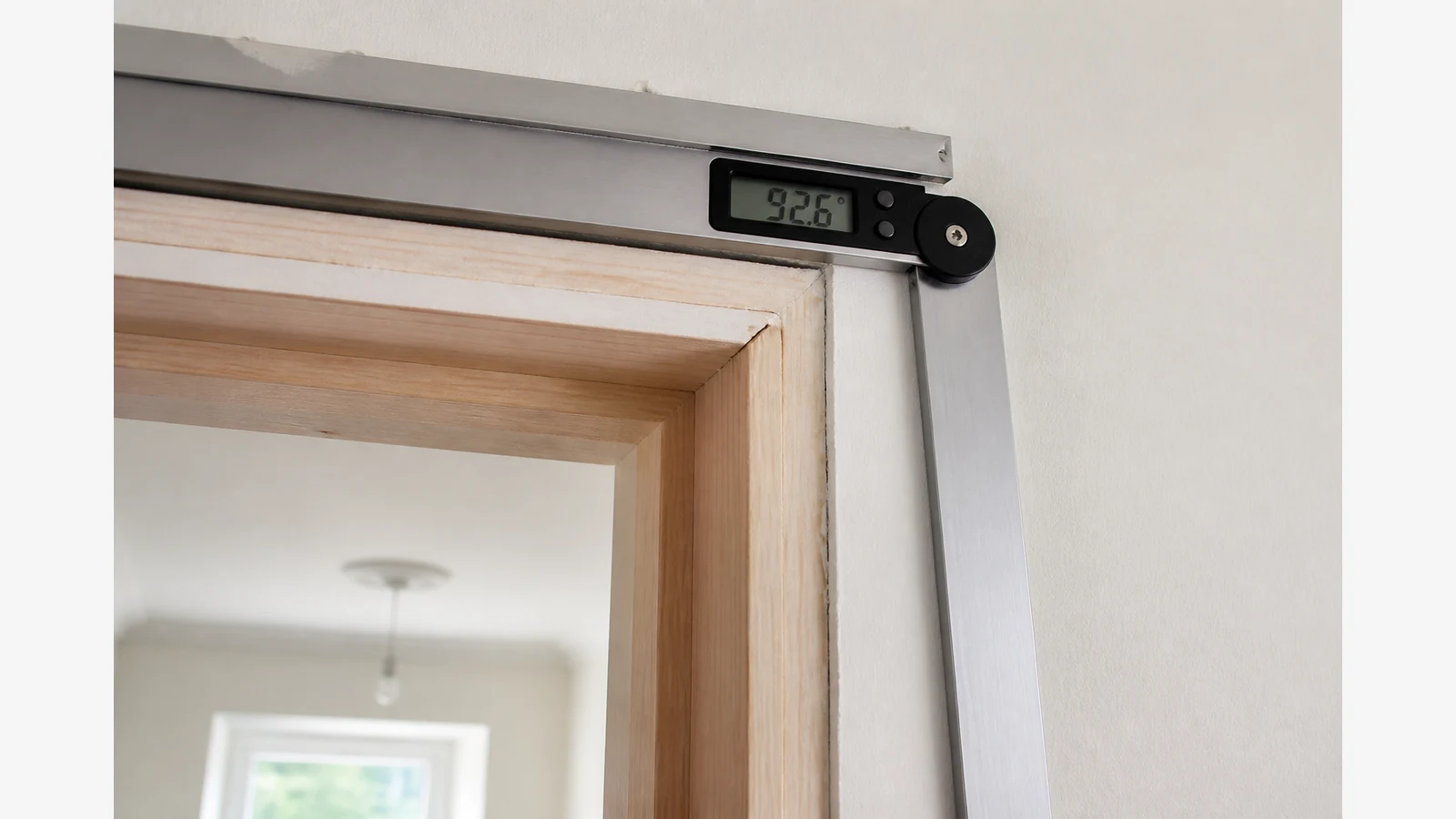
When an architrave mitre opens at the tip, the usual cause is not bad timber — it is assuming every door lining corner is exactly 90°. On renovations and many period frames the corner is a little off, so a default 45° cut leaves a visible V. Measure the actual corner, halve that reading for each mitre, then transfer the half-angle to the saw.
Why default 45° fails on UK door linings
Door linings twist, packs settle, and plaster reveals wander. Retail fitting guides still show opposing head and leg mitres, and the same pattern for windows and loft hatches, but the geometry only works if the corner you cut for matches the corner on the wall. If the lining corner reads 92° or 88°, each mitre should be half of that reading — not 45°.
Keep a consistent reveal (many UK DIY guides use about 6 mm) so the mitre tips land on the same visual line. Margin consistency and correct half-angles solve different problems: a neat margin will not hide an angle error.
Measure, bisect, transfer
- Hold a hinged digital angle ruler so both arms sit flush on the lining face and the wall (or the two faces that meet at the corner).
- Lock and note the inside or outside reading, depending on how your saw scale is marked — stay consistent for the whole doorway.
- Divide by two. That half-angle is the mitre setting for each piece meeting at that corner.
- Set the saw, cut a scrap pair, and dry-fit at the corner before cutting the head length.
- Measure the head between outer mitre tips once the scrap proves the angle, then cut the legs to the floor or skirting junction.
Trade notes often remind fitters that frames are almost never perfectly square and that capturing the real corner with a bevel or angle tool, then halving it, is the reliable path.
Dry-fit order and when to plane
Fit the head first, then the legs, so any tiny length adjustment lands on the longer verticals. A slight back-cut on the reverse face can help the visible face close on uneven plaster, but it will not correct a wrong half-angle. Plane or sand only after a dry-fit shows a hairline that is already nearly closed.
Filler versus recut
- Use filler for paint-grade hairlines after the geometry is correct and the face is closed.
- Recut when the tip gap is wedge-shaped — that is an angle error, not a decoration gap.
- Prioritise correct mitres over perfect margins if you must choose; a tight face reads better than a perfect 6 mm reveal with an open tip.
Keep the tool in the trim bag
Once you have measured the first doorway on a floor, keep the digital angle ruler with the architrave kit. Corners on the same house often differ door to door. Next step: a compact hinged digital angle finder on the product page is enough for lining corners without adding another protractor transfer.
FAQ
Do I always need to leave a 6 mm reveal?
No. Follow the reveal that matches the rest of the house; many UK guides cite around 6 mm as a common starting point, not a regulation.
Internal corners on architrave — measure every time?
Yes on renovations. Factory door kits can be close to square; site-built or old linings often are not.