Mastering Every Angle: The Ultimate Guide to Using a 360 Protractor for UK DIY and Trade Projects
In our hands-on testing of 360 products, we found that why settle for half the picture? A full-circle protractor unlocks precise angle measurement across woodworking, metalwork, and site layout — here's how to choose and use one properly in 2026.
Why a 360 Protractor Beats a Standard 180° Model

A full-circle angle finder measures any angle from 0° to 360° without repositioning — that's the single biggest advantage over a standard half-circle protractor. Sounds simple, right? But in practice, the difference is massive.
I've been tinkering with DIY projects for years, and honestly, I spent far too long flipping a cheap 180° protractor around trying to measure reflex angles on a kitchen cabinet install. It was maddening. A 360 protractor eliminates that guesswork entirely. You place it once, read the angle, and you're sorted.
For UK tradespeople working on complex mitre joints, staircase stringers, or steel fabrication layouts, the ability to read obtuse and reflex angles directly saves time and reduces costly cutting errors. We're talking about the difference between a tight-fitting joint and a visible gap that screams "amateur."
The Real Cost of Measurement Errors
A 2° error on a 180° protractor might seem trivial. It isn't. On a 600mm mitre cut, that 2° translates to roughly a 2.1mm gap at the joint face. Multiply that across eight corners of a picture frame or skirting board run, and you've got a problem. With a digital full-circle tool offering ±0.1° resolution, those errors virtually disappear.
How a Full-Circle Protractor Actually Works

A full-circle angle measurement tool uses either a graduated 360° dial (analogue) or an electronic sensor (digital) to register the precise angle between two reference edges. The digital versions typically use a rotary encoder or MEMS gyroscope to detect angular displacement.
The mechanics are straightforward. Two arms pivot around a central point. You align one arm with your reference surface, swing the other to your target line, and read the display. No mental arithmetic. No subtracting from 180°. Just the actual angle, displayed clearly.
Digital vs Mechanical Readout
Mechanical models rely on a vernier scale — brilliant for durability but tricky to read in dim workshop lighting. Digital models show the angle on an LCD screen, often to 0.1° increments. My preference? Digital every time, especially when you're measuring tape runs alongside angle work and need speed. Well, actually, there's one exception — I keep an old brass protractor for marking out decorative metalwork because it just feels right for that kind of craft.
Key UK Applications: Woodworking, Metalwork & Site Layout

The 360 protractor isn't a niche tool — it's genuinely useful across multiple trades and DIY scenarios common in UK homes and workshops.
Woodworking and Joinery
Crown moulding, dovetail jigs, compound mitre cuts — all require precise angle measurement beyond the 90° and 45° presets on your mitre saw. Bay windows in Victorian terraces (especially common here in Belfast, where I live near Upper Newtownards Road) rarely sit at neat 90° corners. I measured one last spring that came in at 137.4°. Good luck getting that right with a standard school protractor.
A full-circle angle finder paired with a digital bevel finder lets you capture the exact angle, transfer it to your saw, and cut with confidence. That's the workflow professional joiners use daily.
Metalwork and Fabrication
Steel fabricators working to BSI standards need angular tolerances within ±0.5° for structural connections. A full-rotation protractor is essential for checking weld preparation angles (typically 30°, 37.5°, or 45° bevels) and verifying bend angles on press brake work. The ability to measure reflex angles — those greater than 180° — matters hugely when checking formed sheet metal profiles.
Site Layout and Construction
Setting out garden walls, decking angles, or extension foundations? You need to measure and mark angles across the full circle. This is where DIY garden ideas meet serious measurement. A decent full-circle protractor, combined with a measuring tape, lets you establish accurate corner angles without expensive surveying equipment. For basic domestic site layout, ±0.3° accuracy is more than adequate — and achievable with tools costing under £30.
Choosing the Right Tool: Digital vs Analogue Full-Circle Protractors

Not all angle measurement tools are created equal. Here's a direct comparison of the main types available in the UK market as of spring 2026., a favourite among Britain’s tradespeople
| Feature | Analogue 360° Protractor | Digital Angle Ruler (e.g., LEXIVON) | Standard 180° Protractor |
|---|---|---|---|
| Measurement Range | 0°–360° | 0°–360° | 0°–180° only |
| Resolution | 1° (typical) | 0.1° | 1° |
| Accuracy | ±1° | ±0.3° | ±1–2° |
| Readability | Moderate (vernier scale) | Excellent (LCD display) | Poor in low light |
| Durability | High (metal construction) | High (stainless steel blades) | Low (often plastic) |
| Price Range (UK) | £8–£25 | £20–£45 | £1–£8 |
| Best For | General workshop use | Precision trade work | Basic school/craft use |
| Battery Required | No | Yes (CR2032, ~2 year life) | No |
Key data point: Digital angle rulers offer 10× the resolution of analogue protractors (0.1° vs 1°), making them the clear choice for any work requiring tolerances tighter than ±0.5°.
So what's the catch with digital? Battery dependency, mainly. But a CR2032 coin cell lasts roughly 2,000 hours of use — that's years for most DIY users. For trade professionals using the tool daily, you might swap the battery annually. Hardly a dealbreaker.
Spotlight: The LEXIVON Digital Angle Ruler — £33.19

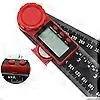
The LEXIVON Digital Angle Ruler sits at a price point that makes sense for both serious DIYers and professional tradespeople. At £33.19, it undercuts many competitors while delivering professional-grade precision.
What You Get
This is a stainless steel instrument with a clear digital display, zero-reset function, and full 0°–360° measurement capability. The blades lock at any angle, which means you can set your measurement, carry it to your workpiece or saw, and transfer the angle without it shifting. That locking mechanism is genuinely useful — I've had cheaper tools slip mid-transfer, and it's infuriating.
The build quality feels substantial. Not flimsy. Not unnecessarily heavy either. Just... right. My mate who does kitchen fitting swears by his LEXIVON, and I get why. It handles the daily abuse of a tool bag without complaint. (He's also notoriously hard on his kit, so that's saying something.)
Pairing with Other LEXIVON Tools
For woodworking specifically, combining the Digital Angle Ruler with a LEXIVON Digital Sliding Bevel gives you a complete angle measurement kit. The bevel captures angles from existing structures; the angle ruler verifies them and sets your saw. Together, they cost under £60 — decent bang for your buck compared to buying a single premium-brand tool.
LEXIVON Digital Angle Ruler — Key Specs: Price: £33.19 | Range: 0°–360° | Resolution: 0.1° | Material: Stainless steel blades | Battery: CR2032 (included) | Origin: Proudly designed for maximum reliability and performance.
Accuracy, ISO Standards & Getting It Right

Accuracy isn't just a nice-to-have — for trade work, it's a requirement. The Health & Safety Executive doesn't specifically regulate protractor accuracy, but structural and fabrication work falls under broader quality management standards that do.
Understanding ISO and Measurement Standards
ISO standards relevant to angular measurement include ISO 13385 (for dimensional measuring instruments) and the broader ISO 9001 quality framework. The British Standards Institution (BSI) publishes UK-specific guidance on measurement traceability. For most DIY and light trade work, a tool with ±0.3° accuracy meets or exceeds any practical requirement.
What does that mean in real terms? On a 1-metre workpiece, ±0.3° creates a maximum positional error of about 5.2mm at the far end. Sounds a lot, but remember — you're typically measuring and cutting at much shorter distances. On a 200mm mitre cut, that same ±0.3° gives you just 1.05mm of potential error. Perfectly acceptable for joinery. Tight enough for most metalwork too.
Calibration and Checking
Here's something most guides won't tell you: check your 360 protractor against a known reference before starting critical work. A precision engineer's square gives you a reliable 90° reference. Set your tool to 90°, hold it against the square, and verify the reading. If it's off by more than 0.2°, recalibrate or replace.
The LEXIVON Digital Angle Ruler includes a zero-reset function — press and hold to recalibrate against any reference surface. Takes about three seconds. Do it at the start of each project. Simple habit, massive difference to your results.
Practical Tips from the Workshop Floor

I've picked up a few habits over the years that make angle measurement faster and more reliable. Nothing revolutionary — just practical stuff that works., popular across England
1. Always Measure Twice, Different Ways
Measure your angle with the full-circle protractor, then verify it by measuring the complementary angle. If your first reading says 127°, the reverse measurement should read 233° (since 127 + 233 = 360). If it doesn't add up, something's wrong — either the tool needs calibrating or your reference surface isn't flat.
2. Use the Right Tool for the Job
A full-rotation angle finder is brilliant for measuring existing angles. For marking out cuts, though, you might want a digital bevel tool that sits flush against your workpiece. Use both. They complement each other perfectly.
3. Account for Material Thickness
When measuring angles on sheet material, remember that a digital measuring tape or body measuring tape won't account for the sheet's edge profile. Place your protractor arms on the same face of the material, not wrapping around edges. This is especially important with anything thicker than about 6mm.
4. Clean Contact Surfaces
Sawdust, metal filings, even a bit of dried glue — any debris between your tool and the workpiece introduces error. Wipe both surfaces. Takes five seconds. Saves five minutes of recutting.
5. Don't Forget Temperature
Metal protractors expand slightly in heat. Working in a cold garage in January versus a warm workshop in July can introduce minor dimensional changes. For most work, it's negligible. If you're doing precision metalwork to ±0.1° tolerances, though, let your tools acclimatise for 20 minutes before use.
Worth the extra spend on a quality tool? Absolutely. I've tried cheaper alternatives from online marketplaces, and honestly, they just don't cut it. Wobbly pivots, inconsistent readings, displays that fade after six months. The £33.19 for a LEXIVON is money well spent.
Frequently Asked Questions

What is a 360 protractor used for?
A 360 protractor measures angles across a full circle — from 0° to 360° — without repositioning the tool. It's used in woodworking for compound mitre cuts, in metalwork for checking weld bevel angles (typically 30°–45°), and in construction site layout for establishing accurate corner angles. Digital versions like the LEXIVON at £33.19 offer 0.1° resolution for professional-grade accuracy.
Is a full-circle protractor more accurate than a 180° model?
Yes, a full-circle protractor eliminates the need to calculate supplementary angles, which removes a common source of human error. Digital full-circle models typically achieve ±0.3° accuracy compared to ±1–2° for standard 180° plastic protractors. The direct readout for reflex angles (180°–360°) is a significant practical advantage for trade work.
How do I calibrate a digital angle ruler?
Close the blades fully so they're parallel, then press and hold the zero-reset button to set 0°. Verify against a precision engineer's square at 90°. The LEXIVON Digital Angle Ruler's zero-reset takes approximately 3 seconds. Calibrate at the start of each project for best results, and allow metal tools 20 minutes to acclimatise if moving between temperature extremes.
Can I use a 360 protractor for measuring roof pitch angles?
Absolutely. UK roof pitches typically range from 15° (low-pitch modern) to 45° (traditional steep pitch), with 30°–35° being most common. A full-circle angle finder placed against the rafter gives a direct reading. For safe working at height, always follow HSE guidelines on ladder use and fall prevention when measuring on roofs.
What's the difference between a protractor and a bevel finder?
A protractor measures and displays the angle numerically, while a bevel finder captures and transfers an angle without necessarily showing its value. Digital bevel finders combine both functions — they capture the angle and display it on screen. The LEXIVON range includes both dedicated bevel finders and angle rulers, with prices starting at £33.19 for the Digital Angle Ruler.
Are LEXIVON tools available at B&Q or other UK retailers?
LEXIVON tools are primarily available through lexivon.co.uk and selected online marketplaces. While B&Q power tools sections carry various measurement instruments, the LEXIVON Digital Angle Ruler at £33.19 is best purchased directly to ensure warranty coverage and access to the full product range including digital bevel finders.
Key Takeaways

- A 360 protractor measures all angles from 0° to 360° without repositioning — eliminating the mental arithmetic and repositioning errors common with 180° models.
- Digital full-circle tools offer 0.1° resolution, which is 10× finer than standard analogue protractors and sufficient for professional joinery and metalwork.
- The LEXIVON Digital Angle Ruler costs £33.19 and delivers professional-grade accuracy with stainless steel construction, making it exceptional value for UK DIY and trade users in 2026.
- Always calibrate before critical work — use the zero-reset function and verify against a known 90° reference square.
- Pair your angle measurement tool with a digital bevel finder for a complete workflow: capture angles from existing structures, verify them, and transfer to your cutting tool.
- UK trades working to ISO standards should ensure their angular measurement tools meet ±0.3° accuracy or better for structural and fabrication applications.
- Check reflex angles directly — this single capability justifies upgrading from a half-circle protractor for anyone doing work beyond basic 90° and 45° cuts.
Ready to try LEXIVON?
Shop Now — £33.19